What The Heck is a Metabolic Belly?
By Dr. J. Renae Norton
Do you have skinny legs and arms and a belly that makes you look about six or seven months pregnant?
Is your belly hard as a rock but the rest of you maybe not so much?
Is your blood work getting worse instead of better despite positive lifestyle changes?
Finally, and most importantly, did you know that fat that is stored in the abdomen can mean a higher risk of heart disease, type 2 diabetes, stroke, and other serious health complications?
If you follow my work, you know that I am a wellness researcher and writer. You may also know that I eat all organic food, that I exercise regularly, and that I am the supplement queen!
And yet for the past year, I have gained weight (in the abdomen only) and found myself trying desperately to manage the problem by reducing my caloric intake.
About three months ago, I realized that I could eat no more than 300 calories a day without gaining weight! That’s when I knew something was very wrong and I needed a new approach. Turns out I was suffering from a condition known as metabolic belly or abdominal obesity.
Mind you I am a fairly small person. I am 5‘7“ tall and I have never weighed more than 135 lbs. and that was when I was about to give birth to my son. I normally weigh between 120 and 125. But my weight was slowly inching up and had reached 130 pounds. For the first time in many years, I was wearing much larger sizes.
Although that was alarming, the weight gain was not the main issue for me. The issue was that I am a foodie. I love to eat! I cook three times a day almost every day. I may go out to a restaurant once every couple of months.
No, the problem was that although all of my food was organic, I was definitely eating the majority of my calories in carbs: Organic fruits, vegetables, crackers, breads, etc. Along with very good protein and very little fat. So despite only allowing myself 10 grams of added sugar a day, I was still raising my blood sugar levels with healthy carbs. Unfortunately, the upshot was abdominal obesity.
I am not alone. Much of the adult American population today suffers from this condition. If you are morbidly obese, you may not even realize that you have the condition. But if you are not morbidly obese, you can tell something is wrong because you have a rock-hard gut that never goes away no matter what you do.
A "metabolic belly," also known as “abdominal obesity” refers to excess belly fat that increases the risk of developing metabolic syndrome and other related health problems. How do you know if you have it? One of the most important biomarkers is a larger waist circumference - more than 40 inches for men and 35 inches for women.
My waist when I started this journey was 36 inches. And my gut (2 inches below the belly button) was 38. After a month and a half of being on keto, my waist is 26 inches, and below the belly, I am 27.5 inches. That is normal for me. At least it was until about seven or eight months ago.
The point is that in the last month because I have been on a keto diet (read Part 1 of my Keto blog here and read Part 2 here) I have lost 10 inches in my waist and 10 inches in my abdomen. I am also sleeping much better and significantly less constipated.
Here's a more detailed explanation:
You’re probably thinking that I must’ve lost a significant amount of weight… Yes and no. I lost 10 pounds, which for me is a significant amount of weight to lose. But considering that I lost 10 inches in my waist and 10 in my gut, 10 pounds is not a huge weight loss. My point is that it’s not about the number of pounds, it is about what caused my waist and abdomen to become so distended in the first place.
Let’s start with Abdominal Obesity:
Abdominal obesity refers to having too much fat stored around the abdomen, specifically the area around the waist and right below. It is caused by having what is referred to as visceral fat. Visceral fat is a type of belly fat that surrounds internal organs like the liver, kidneys, and intestines.
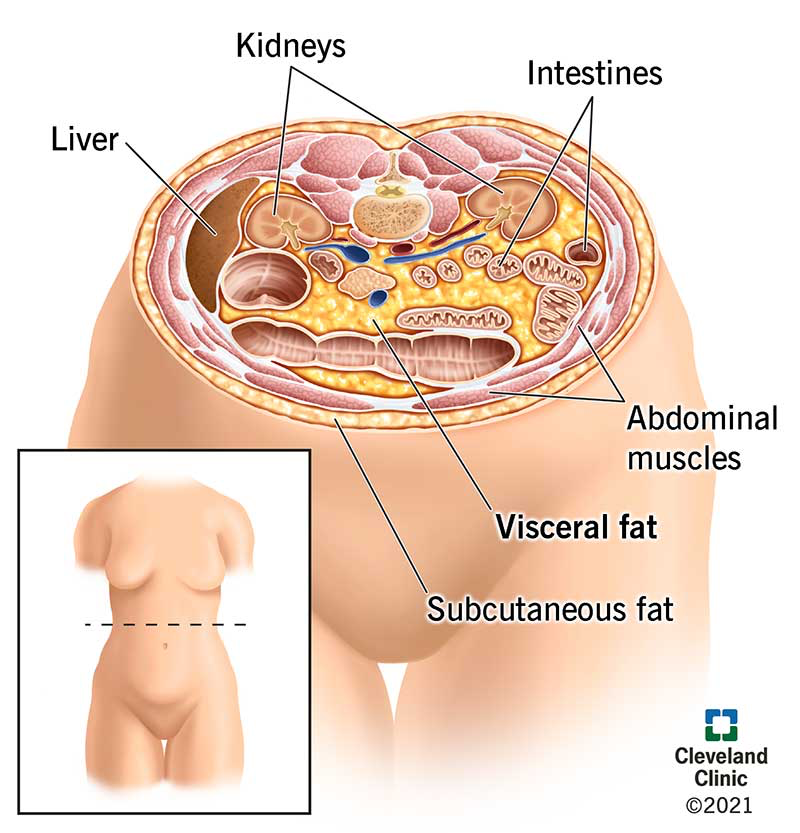
In this diagram, you can see that there is also subcutaneous fat, which is just beneath the skin. That’s normal fat. Can we have too much of it? Oh yes! We can have way too much of it. But the visceral fat, or the fat surrounding our liver, intestines, and kidneys is the bad fat. In fact, visceral fat is quite dangerous.
I never thought I would end up with visceral fat because I eat so clean and because I don’t eat foods with added sugar (except for my Hu Simple Milk Chocolate which I eat in small amounts.)
Turns out, even the healthy carbohydrates I was consuming were really bad for me when it came to the type of fat that they produce. That was hard for me to wrap my head around. Particularly because I am addicted to bread. But bread is one of the things that causes visceral fat. I have discovered that it is better for my body to eat an organic chocolate bar that is made with coconut sugar than it is for me to eat a sandwich made of organic sourdough bread.
In other words, even the organic “healthy carbohydrates”, especially the breads, are really bad for you when it comes to the type of fats that the body stores.
The upshot of all of this is that visceral fat causes metabolic syndrome. Metabolic syndrome refers to a cluster of health conditions that include high blood pressure, high blood sugar, high triglycerides, low HDL cholesterol, and abdominal obesity. This combination of symptoms significantly increases the risk of heart disease, stroke, and type 2 diabetes.
Wow! Up until about a year ago, I had great HDL, great cholesterol, and perfect triglycerides. My blood sugar was high in the morning, but good the rest of the day. But in the last three months, my bloodwork showed that my LDL cholesterol was becoming oxidized and my blood sugar was too high. That is not good! This is in spite of being at a good weight, having no high blood pressure, AND perfect triglycerides.
Another complication of visceral fat is insulin resistance. What? That’s right. Visceral fat can interfere with how your body uses insulin, which is essential for regulating blood sugar levels. Great! So you can be a perfect weight, do your exercise, eat the healthy foods, and you can still have problems with your insulin and blood sugar levels. How can that be? Let’s go back to the visceral fat. I think that is the culprit.
Visceral fat is sometimes called “active fat” because it plays an active role in how your body functions. Too much visceral fat can lead to serious health issues such as diabetes, heart disease, and stroke.
Recall that regular fat, also called subcutaneous fat, is fat that is stored just beneath your skin. (see the diagram above.) It’s the kind that you can pinch between your fingers. Visceral fat is different. Visceral fat is behind your abdominal muscles and can’t be seen. As I mentioned above, it is in your stomach and surrounds your liver, intestines, and other organs. Again, as I mentioned at the beginning of the article, if you suffer from metabolic belly or abdominal obesity as it is called, it looks like you’re six months pregnant after each meal. Eventually, it’s just there all the time.
In terms of what causes visceral fat, it can also be genetics, but the most common cause of visceral fat is a diet high in bad fats and too many carbohydrates. In my case, healthy carbohydrates, and by that I mean organic carbohydrates but still too many.
Finally, stress may also be a factor in visceral fat. It activates a hormone in your body called cortisol also known as the Fight or Flight hormone. Stressing out raises cortisol which activates your body’s “fight-or-flight” response, which triggers the storage of more visceral fat.
So get anxious, get fat?
If eating healthy carbohydrates doesn’t work, what is the solution? I recommend the keto diet because it is extremely low in carbs. I have been on a keto diet for about a month and a half and I believe that as a result, my visceral fat is now just about gone. Certainly, my enormous rock-hard gut is nowhere to be seen. That is despite eating mostly fat, a moderate amount of protein, but almost no carbohydrates. At this point, I believe I will stay on a low to no-carb diet more or less permanently. There is not enough research on the long-term effects of the keto diet. I may take a break every once in a while just to add certain fruits and vegetables to my diet, but in general, I believe that this is an easy and delicious way to avoid very dangerous conditions.
When it comes to the anxiety you are experiencing that you now know raises your cortisol levels and contributes to visceral fat, therapy is your best bet.
If you want help with the anxiety and/or learning how to do keto, call me at 513-205-6543 or schedule free 15 minute consultation call below. I can help. I am the Mind Weight Wellness Pro and I am here to show you how to solve the problem.