Is Thyroid Disease an Epidemic in The U.S. ? And if So, Why?
By: Dr. J. Renae Norton
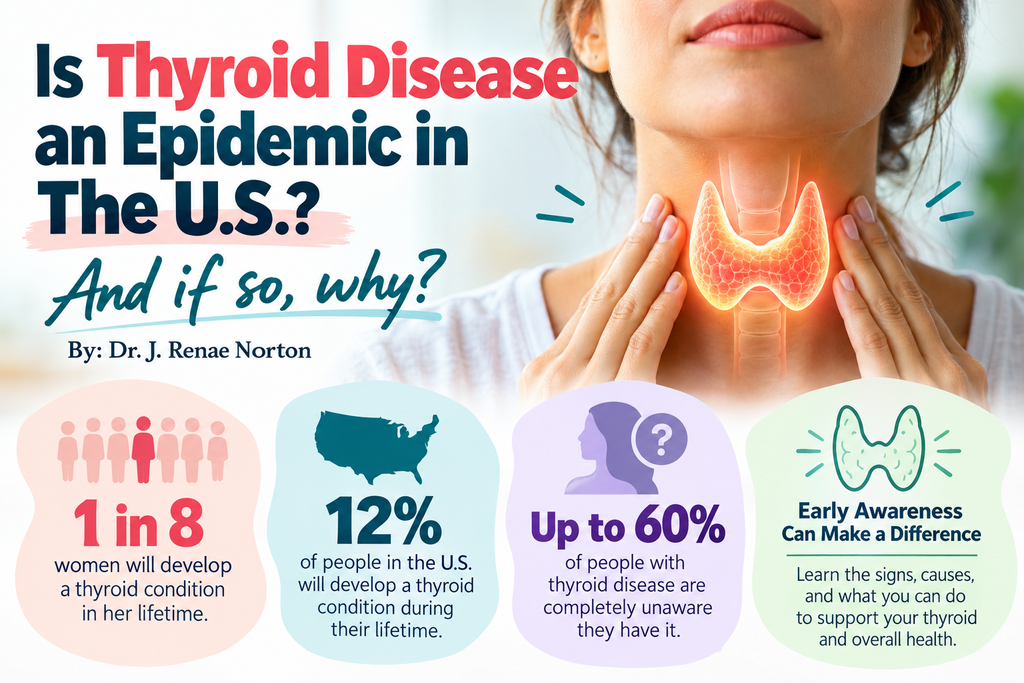
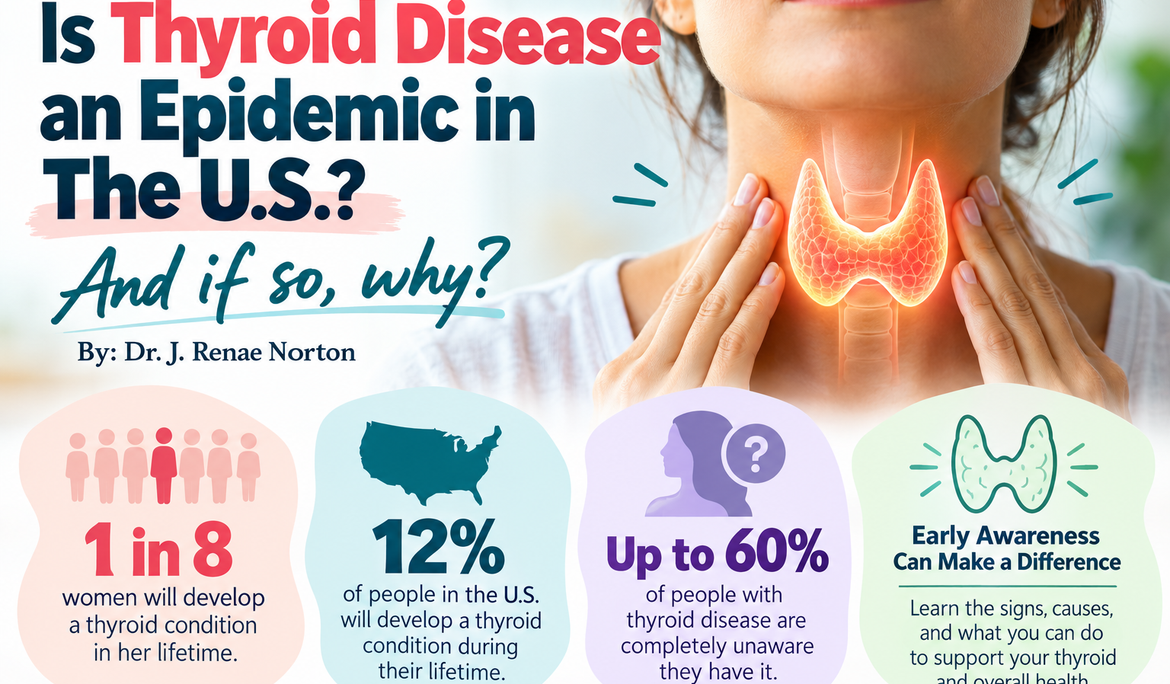
Did you know that about 12% of people in the U.S. will develop a thyroid condition during their lifetime?. [1] This is in comparison to somewhere between 5 and 9% of the population of the European Union. So we are almost double.
The Undiagnosed Gap: the problem with this data, especially in the United States is that up to 60% of people with thyroid disease are completely unaware they have it because symptoms like fatigue or weight changes are often blamed on stress or aging. [1, 2]
Gender Disparity: there is also a very definite difference between males and females when it comes to thyroid disease, in as much as women are 5 to 8 times more likely than men to develop thyroid problems, with roughly 1 in 8 women facing a diagnosis in her lifetime. [1, 2] Wow, one and every eight women!
The Most Common Types of Thyroid Disease
There are a couple of variants when it comes to thyroid disease. Hypothyroidism also known as and an underactive thyroid gland makes too little hormone, slowing metabolism and causing fatigue, weight gain, and cold sensitivity. It is often caused by Hashimoto’s disease. [1, 2]
Hyperthyroidism or an overactive thyroid gland, produces too much hormone, speeding up metabolism often causing rapid weight loss, anxiety, and a fast heartbeat. It is often caused by Graves’ disease. [1, 2]
Finally, and actually worst case scenario is thyroid cancer, which present as lumps on the thyroid itself. They are fairly frequent, which is the bad news, but the good news is that they are slow to progress and have a very high survival rate. [1]
So how do we end up with thyroid disease? In general, it starts with something called autoimmunity. What this means is that the immune system instead of protecting us create act that act against your thyroid gland. The best example is Hashimoto’s thyroiditis, a condition that is triggered by too much gluten and a leaky gut. If you follow my publications, you will know that I speak of leaky got frequently. It is the most common cause of some of the most serious diseases that we suffer in this country, thyroid disease being the most common. It is also the easiest to fix.
There are many things that attack the gut and cause a leaky gut. The most common causes of a weak gut are polluted foods. What do I mean by polluted? Primarily I am talking about foods that are doused in life estate or round up, and herbicide that kills weeds. We represent 4% of the world population, but we eat 33% of the world‘s life estate. We are literally drowning in it . Clover seat is spectacularly good at tearing holes in our gut. When that happens, we end up with auto immune diseases like Hashimoto’s.
So you are in control of this disease. You can prevent it and you can heal it. What do you have to do? You must eat an all organic, grass fed, wild caught, minimally, processed diet.
You must also heal the gut. The only thing that’s ever been shown to effectively heal a leaky gut is bone broth. I make my own bone broth and I either have a cup of it or I poach my food in it every day. It is so delicious! Last night for dinner I had pork tenderloin and I poached it in a half a cup of bone broth just enough to flavor it. I sliced the pork tenderloin to half inch pieces and then just sautéed them in the bone broth… You have never tasted more tender and more flavorful pork tenderloin in your life. You can do the same thing with beef tenderloin, although many people like their beef tenderloin rare but for those of you who like your beef medium rare, this is a an amazing way to prepare any meat, fish, or foul. bone broth is incredible.
Not only is bone broth incredible when it comes to healing the gut, it is delicious and the things that you simmer in it will be equally as delicious.
There are a few other things that can impact your thyroid, one of which is the need for surgery such as in the case of thyroid cancer. For some people, the thyroid is inhibited due to:
- An issue in the pituitary gland (in the brain) which can release too much TSH and cause hyperthyroidism.
- Certain Medications such as Lithium which is a very commonly used medication to treat bipolar disorder.
- Treatment for hyperthyroidism (over-active thyroid) can end up causing hypothyroidism.
Symptoms of thyroid disease:
Most thyroid disease go untreated, despite the fact that the symptoms are very easy to spot. They include the following:
- Low energy at any point during the day
- Difficulty losing weight (even with exercise)
- Feeling cold (even at normal room temperature)
- Hair loss (head and eyebrows) and/or coarse hair or nail changes (ridges, weakness)
- Dry skin
- Low mood
- Poor memory
- Headaches
- Fluid retention
- Joint pain
- Menstrual issues
- Constipation
Thyroid disease is very common, affecting about 20 million people in the United States alone. [1]
If you suspect you might have an issue, would you like to know the common warning signs to watch for or how doctors test for thyroid function?