
BY Dr. J. Renae Norton
Why is the thyroid so important? And why don’t we hear more about it?
Good question…Because in point of fact, the thyroid gland, which is one of the largest endocrine glands, plays a role in almost every physiological process in the body. For starters, it regulates metabolism and weight by controlling how well we burn fat. Let’s think about this. The thyroid is basically what determines our weight because it regulates how fast (or slow) we burn calories. In other words, if it isn’t working you may gain (or lose) weight no matter what you eat and how much you workout. But it also interacts with other glands and their hormones to impact mood, fertility, tissue growth, sexual and menstrual function, bone metabolism and more. It greatly influences every cell in the body throughout the life cycle and as such, it is a deceptively complex organ. Have a look at the chart below:

I became interested in the thyroid because so many of my patients with eating disorders and obesity were having thyroid issues. One of the consequences of being severely anorexic, bulimic or obese is that your thyroid comes under attack. Conversely, I discovered that thyroid disease can lead to an eating disorder and/or obesity. So it works both ways.
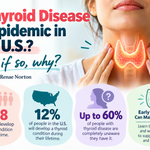
It is important that practitioners and patients know about this connection as it can make all the difference when it comes to recovery for many diseases and disorders. Unfortunately, 60 % of all thyroid disease goes undiagnosed. You read that right, 60 % for a gland that impacts every organ and system in the body.
How is that even possible? You have heard me say it before and I am saying it again; in today’s medical community, the goal is to treat the symptoms, not the diseases. The pharmaceutical companies and the mega practices make more money that way. The patients are the losers in this scenario.
So the fact that the connection between thyroid disease and other health problems is not widely recognized by the lay public or publicized by medical practitioners is really not surprising. The reality is that the thyroid has been implicated in everything from fibromyalgia and carpal tunnel syndrome to hives and rosacea.
The fact that thyroid disease goes undiagnosed more often than not according to alternative medicine practitioners explains a lot about crazy symptoms and weight problems that so many people have. This has certainly been my experience. Many of the patients I have seen regularly over the past 4 years, only 3 of the 19 ending up with thyroid disease came in with a diagnosis of the disease. (They were all three in the same family.)
The other 16 patients, who did end up with a diagnosis of thyroid disease had not previously been diagnosed. The only reason they were eventually diagnosed is that I pushed so hard for them to be tested.
I am fairly certain that a high percentage of the remaining patients also may have had thyroid problems, I just couldn’t convince them to get the necessary testing done to rule it out. I assume that because we were able to resolve their eating disorders and/or obesity, the thyroid issues also resolved for many of them. However, if I’m being honest, I am haunted by the knowledge that some of them probably have undiagnosed thyroid disease, which can cause problems that are life-threatening and/or debilitating over time if left untreated. Since they are no longer in treatment, my only hope is to publish this information and hope that they see it.
One good example of a condition that would not normally be associated with the thyroid disease is the intense anxiety that it can cause. I had a young man present for treatment at 98 pounds (who now weighs a muscular 164 pounds) who looked flagrantly psychotic because he was so anxious. He was having hallucinations and was experiencing paranoid ideation. I didn’t think the young man was psychotic, as I had seen this dynamic in several other anorexic individuals. I thought it was a combination of intense anxiety and starvation and I believed that by treating the eating disorder we would be able to get him off of the antipsychotic medication.
In addition to the eating disorder and apparent psychosis, I suspected thyroid disease and in fact, he tested positively for hypothyroidism. Weight restoration, which began immediately, did in fact allow us to take him off of the atypical antipsychotic meds within 3 months. A year after being on a naturopathic thyroid medication and with full weight restoration, he was also recovering from the hypothyroidism.
I believe that this young man’s eating disorder was attacking his thyroid. As I mentioned above, I also see patients who have thyroid disease that I believe drives an eating disorder and/or obesity for these individuals. The point is that there appears to be a strong connection based upon my anecdotal observations and the research that I can find on the subject. The implication is that if you do not know about this connection as a patient, you may suffer needlessly. If you do not know about this connection as a practitioner, you may not be as effective in treating the presenting condition.
Stay tuned for the symptoms, the causes and the types of thyroid disease and what you can do if you suspect that you in fact have a sick thyroid.