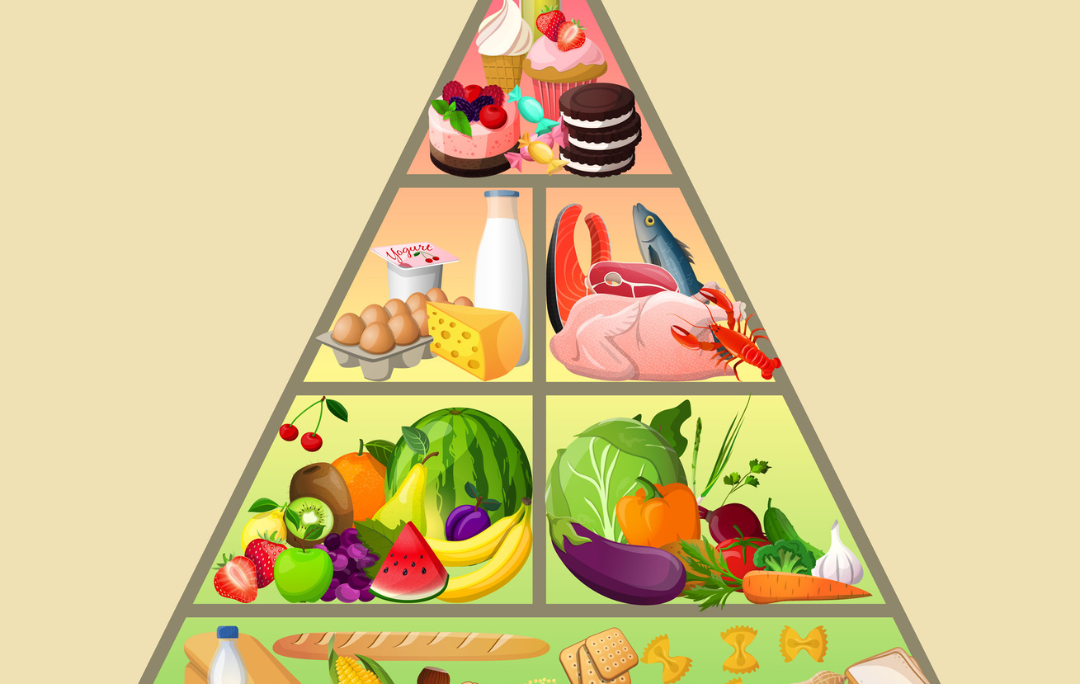
Let’s take a minute to talk about all of these food pyramids that exist today. We have the USDA Food Pyramid, the Paleo Pyramid, and the Keto Pyramid to name a few. Where did they come from? Because they really don’t make sense when you think about it. They start with the assumption that we should eat far more of one food group than any of the other food groups. Turns out that’s not really true.

I remember when the US government first came out with the food pyramid in 1992. Butter was demonized and was at the top of the pyramid and grains and rice were the main staples at the bottom. Today, we know that the authors of the food pyramid were not only misinformed but that following its prescriptions can actually be harmful and often does contribute to an unhealthy diet.
How exactly did the government get something so crucial to the everyday life of the American people so wrong? First, we have to understand what was at issue at that time. Underlying the recommendations was the fact that most people in the US were undernourished. In other words, they needed more nutrition, without raising the cost. The only question then was, what is the best way to get the most caloric bang for your buck? Carbs of course. From here we ended up with way too many carbs and, perhaps even worse, the glorification of a low-fat diet.
Today, we know that fats aren’t necessarily “bad” and that eating low-fat foods often causes its own problems because when they take the fat out, they usually put sugar in its place. Unfortunately, consumers ended up replacing the high-fat foods (the good ones and the bad ones) with highly processed, low-fat foods, many of which were junk foods.
For the American public, this was the beginning of equating “low-fat” with “healthy” and that, of course, just isn’t true. Fat is good for you and absolutely essential. In addition to this fat is not fattening. You do not gain weight by eating fat. That’s why Keto is so effective despite the fact that it is 75% fat. On the other hand, even if you combine good fat with too much sugar, you will gain weight. Ultimately the USDA Food Guide Pyramid, in encouraging Americans to prioritize consuming carbohydrates, resulted in diets dominated by unnecessary calories, sugar, and starches.
The other problem with the pyramid is the recommended amount of grains. Yes, grain is cheap, but still, why so much of it? According to many researchers on this topic, the fact that the base of the pyramid was a “grain” was heavily influenced by lobbying efforts from the grain industry. The type of grains suggested by the pyramid was also a problem. The pyramid didn’t emphasize whole grains but instead encouraged the intake of refined grains, such as bread and pasta. Big mistake.
Finally, there was, and still is a lot of confusion on how the heck they define a serving. Turns out there is a booklet that accompanies the pyramid that defines what is meant by a serving. According to the accompanying booklet that no one knows about, a single bagel—which most of us would consider a serving of grain—actually weighs in at somewhere between 6 and 11 servings. What? For starters, which is it, 6 or 11? What does the range mean? But if that is true, and 1 bagel is a 6 to 11 grain serving, then it isn\’t a lot of grain, right? I question whether it is even a pyramid at all. Grains are 6 to 11 servings, fruits and vegetables are 6 to 9 servings, and meat and dairy is 7 to 10 servings. That is not a pyramid.
In addition, the pyramid, with its base of carbs, didn’t differentiate between the various types of carbohydrates, including simple, complex, and processed. Again, what? All carbs are not the same, but the food pyramid does not make this clear.

Given how egregious these problems are, what is really amazing is how many new food pyramids we have that appear to follow some of the same assumptions. I take issue with these assumptions. I think we need a variety of foods and food groups to be healthy. Although I gravitate towards a “Mediterranean” diet, which includes fruits and vegetables, grains, fats, and proteins from a variety of sources, I don’t see one of these groups as being dramatically more critical or important than any of the others. As far as I am concerned we need them all. So I am not presenting a food pyramid. Maybe a food cube or a food circle? I’ll keep working on it. If you have any ideas, reach out to me at DrNorton@EatingDisorderPro.com.
Source:
Food Surveys Research Group, Cleveland, L. E., Cook, A. J., Wilson, J. W., Friday, J. E., Ho, J. E., & Chahil, P. S., Pyramid servings data: Results from USDA\’s 1994 continuing survey of food intakes by individuals 1–20 (1997). Beltsville, MD; Food Surveys Research Group, Beltsville Human Nutrition Research Center, Agricultural Research Service, U.S. Dept. of Agriculture.