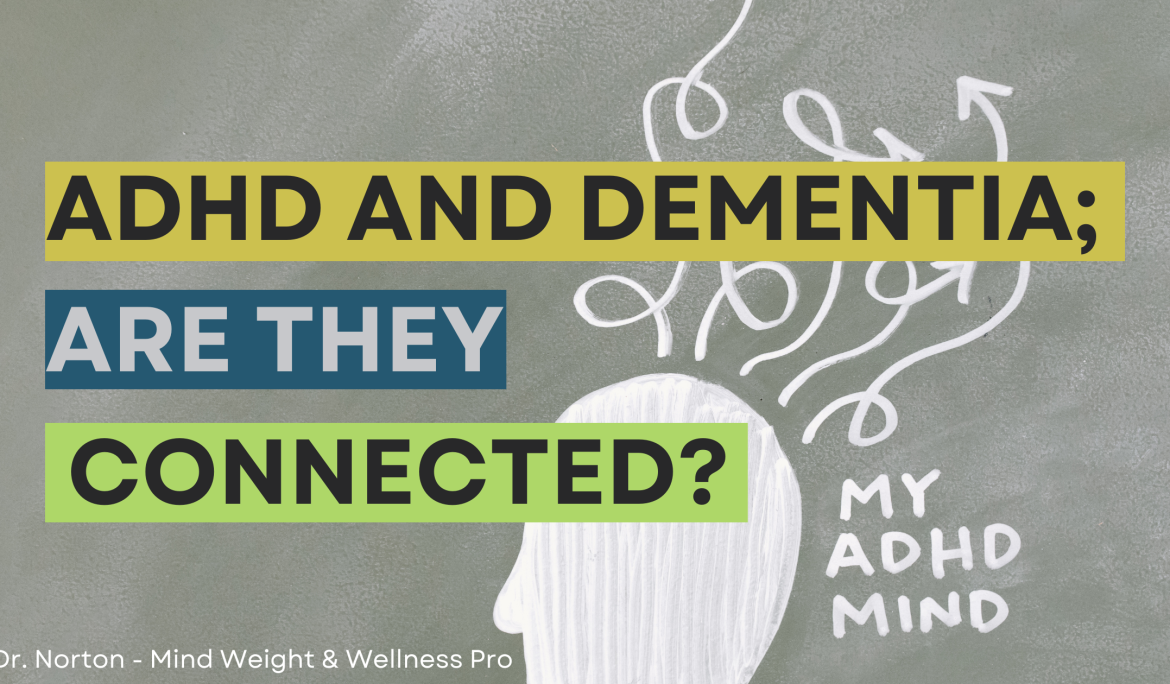
As we age, we notice a decline in cognitive function which may ultimately lead to dementia. Turns out the aging process begins much earlier than you might expect. Experts say that it actually starts in our mid-40s.
But for those of us who have ADD or ADHD it feels like it began in childhood. As children we experienced many of the same types of cognitive problems seen in dementia. Trouble remembering words, names, where we put things, directions, staying on task, etc.
Turns out there may be a connection between dementia and ADHD. But it’s not what you might expect.
The Karolinska study in Sweden looked at more than two million people born in Sweden between 1980 and 2001, and found that about 3 percent were diagnosed with ADHD. National registries were used to link the people in the study with biological relatives — in all, about five million parents, grandparents, aunts and uncles — to investigate whether the relatives developed dementia. The rate of dementia for relatives of individuals with ADHD was compared to the rate of dementia for relatives of individuals without ADHD. The results are stunning, as well as confusing.
This is what they found:
-
The risk of dementia was 34 percent higher for parents of individuals with ADHD than for parents of individuals without ADHD. The risk for grandparents of individuals with ADHD was 10 percent higher.
-
The risk of Alzheimer’s disease, the most common type of dementia, was 55 percent higher for parents of individuals with ADHD than for parents of individuals without ADHD.
-
Parents of individuals with ADHD were more likely to have early-onset dementia than late-onset dementia.
Yikes!
There was some good news in as much as the researchers noted that even though parents of kids with ADHD had a significantly increased risk of dementia, their absolute risk remained low. Overall, only 0.17% of the parents identified in the study were diagnosed with dementia during the follow-up period.
The confusing part is that they could not identify a cause-and-effect for the data. Why were the parents more likely to end up with dementia? A question I had after reading their results was whether or not having ADD yourself increases the likelihood of having dementia? That was not part of the study.
The bottom line for this study was that they could not identify the cause. This research is strictly correlational so that’s not surprising. They did have some interesting theories.
One theory was that there might be a genetic connection but even the largest genetic studies on ADHD and dementia to date have failed to make that connection.
Another theory was that ADHD increases the risk of medical health conditions, which in turn might lead
to an increase risk of dementia. They based this theory on the fact that ADHD children and adults have been associated with excess weight and more obesity in middle age, both of which have been positively linked with an increased risk of dementia later in life. So they’re theory is that having ADD might increase your risk of having other medical problems, and then in turn might increase your risk of having dementia.
I have a different interpretation which I think is more straightforward. I believe the same thing that causes obesity causes the dementia. In other words, in my experience it is very much diet related. We have terrible diets here in the US. We are the most obese country in the world with the most obese children in the world. So it’s not surprising that ADD and dementia are on the rise based on the research mentioned above.
I have personal experience that diet matters when it comes to cognitive function; whether it is ADD or dementia. I also have many examples among my patients over the years. In my case, I have the gene for dementia but the gene is no longer active. I was beginning to see symptoms of dementia about 10 to 12 years ago. But radically changing my diet effectively turned the gene off and reversed the dementia. I have always been ADD but have never been greatly affected by it. It has been more of an inconvenience.
So to be clear, I believe the reason I was able to reverse what was clearly the onset of dementia years ago was that I radically changed my diet, effectively eliminating, added sugar and all processed foods. I also supplement with MCT oil which has been shown to reverse Alzheimer’s when combined with exercise. I have shared this information with ADD and older patients most of whom have had similar outcomes. As is my ADD grandson, a change to his diet also made it possible for him to stop taking ADD medications.
There’s good data to back up how bad sugar is for the brain so that was not terribly surprising. The coconut oil was more of a surprise. That was a discovery made by a physician here in Cincinnati Dr. Mary Newport when she treated her husband with coconut oil to slow down his Alzheimer’s. To this day, I continue to use copious amounts of MCT oil and exercise regularly.
There are a number of other supplements that are very effective when it comes to supporting the brain. Stay tuned for the follow up article on each of these supplements, and how they work.
If you’re having difficulty with your weight, if you have ADHD, or if you think you’re showing signs of Alzheimer’s please reach out to me at 513-205-6543. I am the Mind Weight and Wellness Pro and I can help.
References
Crawford, C., Boyd, C., Avula, B., Wang, Y. H., Khan, I. A., & Deuster, P. A. (2020). A Public Health Issue: Dietary Supplements Promoted for Brain Health and Cognitive Performance. Journal of alternative and complementary medicine (New York, N.Y.), 26(4), 265–272. https://doi.org/10.1089/acm.2019.0447
Jamal, Q., Siddiqui, M. U., Alharbi, A. H., Albejaidi, F., Akhtar, S., Alzohairy, M. A., … & Kesari, K. K. (2020). A computational study of natural compounds from bacopa monnieri in the treatment of alzheimer’s disease. Current Pharmaceutical Design, 26(7), 790-800.
Gareri, P., Castagna, A., Cotroneo, A. M., Putignano, S., De Sarro, G., & Bruni, A. C. (2015). The role of citicoline in cognitive impairment: pharmacological characteristics, possible advantages, and doubts for an old drug with new perspectives. Clinical interventions in aging, 10, 1421–1429. https://doi.org/10.2147/CIA.S87886
Lopez, C. M., Govoni, S., Battaini, F., Bergamaschi, S., Longoni, A., Giaroni, C., & Trabucchi, M. (1991). Effect of a new cognition enhancer, alpha-glycerylphosphorylcholine, on scopolamine-induced amnesia and brain acetylcholine. Pharmacology, biochemistry, and behavior, 39(4), 835–840. https://doi.org/10.1016/0091-3057(91)90040-9
Molin, A. (2021, September 9). Link between ADHD and dementia across generations | Karolinska Institutet Nyheter. News from Karolinska Institutet. Retrieved August 16, 2023, from https://news.ki.se/link-between-adhd-and-dementia-across-generations
Montgomery, J. (2023, August 1). Best Nootropics of 2023: Top 5 Nootropic Supplements, Smart Pills, & Brain Boosters. The Dallas Morning News. Retrieved August 16, 2023, from https://www.dallasnews.com/branded-content/2023/08/01/best-nootropics-of-2023-top-5-nootropic-supplements-smart-pills-brain-boosters/
Peth-Nui, T., Wattanathorn, J., Muchimapura, S., Tong-Un, T., Piyavhatkul, N., Rangseekajee, P., Ingkaninan, K., & Vittaya-Areekul, S. (2012). Effects of 12-Week Bacopa monnieri Consumption on Attention, Cognitive Processing, Working Memory, and Functions of Both Cholinergic and Monoaminergic Systems in Healthy Elderly Volunteers. Evidence-based complementary and alternative medicine : eCAM, 2012, 606424. https://doi.org/10.1155/2012/606424
Small G. W. (2002). What we need to know about age related memory loss. BMJ (Clinical research ed.), 324(7352), 1502–1505. https://doi.org/10.1136/bmj.324.7352.1502
Tang, X. C., De Sarno, P., Sugaya, K., & Giacobini, E. (1989). Effect of huperzine A, a new cholinesterase inhibitor, on the central cholinergic system of the rat. Journal of neuroscience research, 24(2), 276–285. https://doi.org/10.1002/jnr.490240220
Top 5 Supplements. (n.d.). These Top 5 Brain Supplements Can Help Sharpen Memory and Boost Cognition. Top 5 Supplements. Retrieved August 16, 2023, from https://www.top5supplements.com/buying-guides/memory-supplements
Weiser, M. J., Butt, C. M., & Mohajeri, M. H. (2016). Docosahexaenoic Acid and Cognition throughout the Lifespan. Nutrients, 8(2), 99. https://doi.org/10.3390/nu8020099
Zhang, J., An, S., Hu, W., Teng, M., Wang, X., Qu, Y., Liu, Y., Yuan, Y., & Wang, D. (2016). The Neuroprotective Properties of Hericium erinaceus in Glutamate-Damaged Differentiated PC12 Cells and an Alzheimer’s Disease Mouse Model. International journal of molecular sciences, 17(11), 1810. https://doi.org/10.3390/ijms17111810