
PERSONALITY DISORDERS
We all have personalities, some of which are quirkier than others, but what makes for a personality disorder? According to the DSM-5-TR, a personality disorder “…is an enduring pattern of inner experience and behavior that deviates markedly from the norms and expectations of the individual’s culture. It is pervasive (dominates the personality) and inflexible (hard to change.) It usually becomes an issue in adolescence or early adulthood. Most importantly it leads to problems in relationships and the individual’s ability to be successful.
Personality disorders have four defining features:
Distorted thinking patterns
Problematic emotional responses
Over- or under-regulated impulse control
Interpersonal difficulties
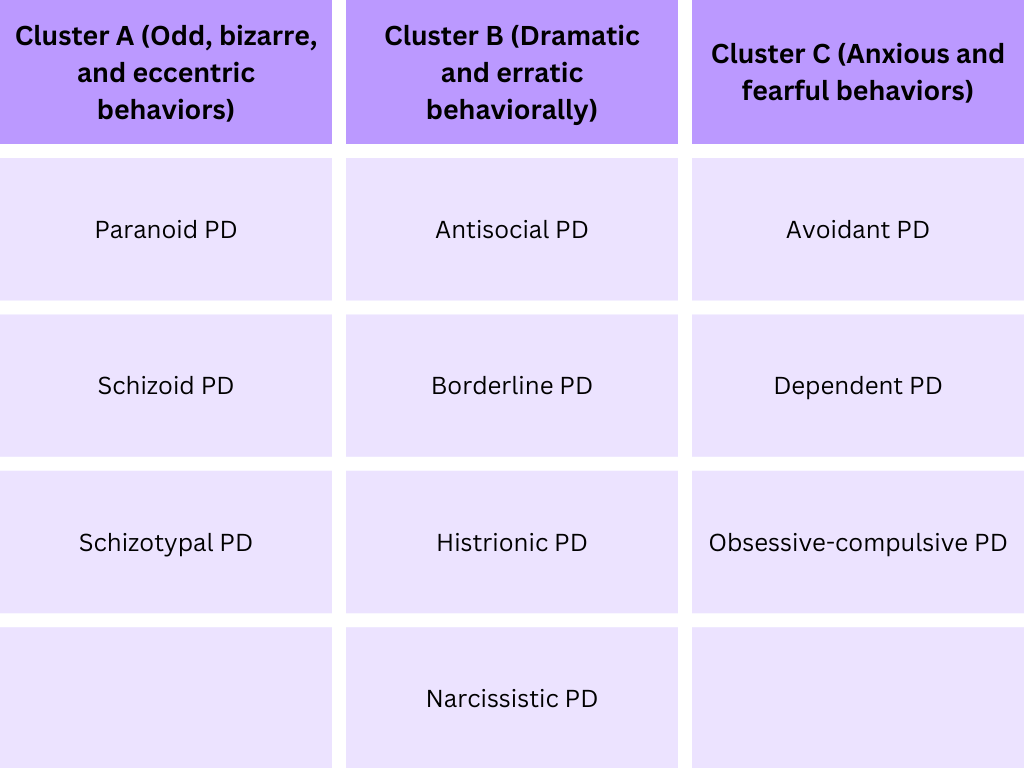
While these four core features are universal among all ten personality disorders, the DSM-5-TR groups the 10 personality disorders into three different clusters based on symptom similarities.
Cluster A is described as the odd or eccentric cluster and consists of paranoid, schizoid, and schizotypal personality disorders. The common feature between these three disorders is social awkwardness and social withdrawal. Although some of the behaviors are similar to those seen in schizophrenia, they tend to be less damaging in terms of the individual’s ability to function as compared to full-blown schizophrenia.
Cluster B is the dramatic, emotional, or erratic cluster and consists of antisocial, borderline, histrionic, and narcissistic personality disorders. Individuals with these personality disorders often experience problems with impulse control and emotional regulation. Due to the dramatic, emotional and erratic nature of these disorders, it is challenging for these individuals to establish healthy relationships with others.
Cluster C is the anxious or fearful cluster and consists of avoidant, dependent, and obsessive-compulsive personality disorders. Cluster C disorders tend to overlap more with symptoms from the anxiety and depressive disorders. As a result, they end up having more treatment options than the other 2 clusters of personality disorders.
It is important to note the even when they display the symptoms, children cannot be diagnosed with a personality disorder. You must be 18 according to the DSM-5-TR.
The Clusters are as follows:
PERSONALITY DISORDER DESCRIPTIONS
It is important to note that the majority of people with a personality disorder never come into contact with mental health services. Unfortunately, those who do are usually in crisis, are suffering from another mental disorder, are engaged in self-harm or are breaking the law.
CLUSTER A (ODD, BIZARRE, AND ECCENTRIC BEHAVIORS)
1. Paranoid personality disorder (PD)
Paranoid PD is characterized by a pervasive distrust of others, including even friends, family, and partners. As a result, this person is guarded, suspicious, and constantly on the lookout for data to validate their fears. Such individuals have a strong sense of personal rights and may be hypersensitive to perceived setbacks. They believe that they are rebuffed when they are not. They often end up feeling shame or humiliation over perceived persecution. It is not uncommon for such individuals to bear a grudge for many years.
Not surprisingly, they tend to withdraw from others and may struggle with relationships. The principal ego defense in paranoid PD is projection (attributing their own judging thoughts to others. )
The most interesting case I have had was with a gentleman who was too paranoid to take a vacation. The government organization for which he worked referred him to a mental health clinic where I was doing an internship. All attempts to reassure him that it was safe for him to take his vacation had backfired, convincing him that his employers and the therapists “working” for them, were plotting to get rid of him by planting false evidence while he was away. I was being trained in a type of systems theory that employs a “paradoxical” intervention (reverse psychology.) The approach required me to insist that he stand his ground, refuse to take a vacation and basically resist the people pressuring him to do so.
“You need to really buckle down and just plan on working straight through to retirement. It’s only 23 years. It won’t be easy, but you can do it. You have already gone for almost ten years with no vacation…what’s 23 more?” At this point we are in synch as he is nodding. The technique uses “pacing and then leading” so this is good. “Let’s start planning what it will take for you to manage your life without ever taking a day off.” Initially he was relieved, thrilled even. So much pressure off of him. So I pushed harder on getting him to commit to never taking any time off. Not for illness, vacations, family gatherings, etc. Our work was raising a lot of issues of the cost and inconvenience of never having any time off. Finally, after a few weeks he began to push back, stating the unfairness of never being able to take time off. Ultimately, he enlisted my help in dealing with the anxiety caused by his paranoia over taking his first two-week vacation.
2. Schizoid PD
The term “schizoid” technically means a natural tendency to focus on one’s inner life away from the external world. A person with schizoid PD appears detached and may be viewed as aloof. Not only are they more prone to introspection, they also often engage in fantasy. Typically, they have no desire for social or sexual relationships, and they are more or less indifferent to the presence of others. They do not observe social norms and conventions. They rarely display emotion.
While this is the typical view, I have found many schizoid patients to be highly sensitive with a rich inner life. The problem for most of them is that although they may long for intimacy, initiating and/or maintaining close relationships is just too difficult and distressing, so they retreat back into their own inner world. It is unusual for someone with schizoid PD to seek treatment. Partly because it is so difficult for them to form close relationships, but also because they are generally well functioning and quite untroubled by their apparent oddness.
3. Schizotypal PD
Schizotypal PD is closer to what we think of when we think of schizophrenia. It is characterized by oddities of appearance, behavior, and speech, as well as hearing or seeing things that aren’t there. They also display problems with thinking that is similar to what we see in those suffering from schizophrenia. These include odd beliefs, what is known as “magical thinking” (for instance, thinking that speaking of the devil can make him appear), suspiciousness, and obsessive ruminations.
The one thing that really distinguishes the schizotypal PD from the Schizoid PD is that they actually do fear social interaction and see most people as harmful. They often have ideas of reference, or beliefs that events taking place around them are somehow related to them in a bad or threatening way. People with schizotypal PD have a higher than average probability of developing schizophrenia, which is why the condition used to be called “latent schizophrenia.” What separates them from the diagnosis of schizophrenia is that they have not completely lost touch with reality.
CLUSTER B (DRAMATIC AND ERRATIC BEHAVIORALLY)
4. Antisocial PD
Antisocial PD is much more common in men than in women and is characterized by a callous unconcern for the feelings of others. The person disregards social rules and obligations, is irritable and aggressive, acts impulsively, lacks guilt, and fails to learn from experience. Paradoxically however, s/he has no difficulty finding relationships — and can even appear superficially charming (the so-called “charming psychopath”) — but these relationships are usually fiery, turbulent, and short-lived. I have found that the Antisocial PD often has many of the symptoms, if not a full out diagnosis of Narcissistic and/or Borderline PD in addition to the Antisocial PD diagnosis.
Given that the antisocial PD is the mental disorder most closely correlated with crime, individuals with antisocial personality disorder are most likely to have a criminal record or a history of being in and out of prison. In fact it is often trouble with the law, the threat of divorce, the loss of a job or the threat of being kicked out of school that brings this individual in for treatment. In my experience these individuals tend to be very bright, and in that sense, make great patients. The tricky part is that they are also very good at manipulating others including practitioners.
5. Borderline PD
In borderline PD, the person essentially lacks a sense of self and, as a result, experiences feelings of emptiness and fears of abandonment. There is usually a pattern of intense but unstable relationships, emotional instability, outbursts of anger and violence (especially in response to criticism), and impulsive behavior. The borderline parent is famous for splitting her children, pitting one against the other(s) or pitting them against her spouse. Suicidal threats and acts of self-harm are common, making this disorder a common one for practitioners. Though common, this group is not easy to treat as they have difficulty with boundaries, even therapeutic ones, and often feel abandoned if the therapist is not always on their side.
For example, because they engage in “splitting” among their family members, the expectation is that the therapist will always side with them. When that does not happen, it is not uncommon for the borderline to attack the therapist or the therapy. It is for this reason that practitioners often try to avoid treating borderlines. I limit myself to helping one borderline at a time.
Borderline personality disorder is more common among women. (At least it is more likely to be diagnosed in women.) There is some research suggesting that it often results from childhood sexual abuse and since women are more likely to suffer sexual abuse the argument is that women are more at risk. Feminists have argued that borderline PD is more commonly diagnosed in women, because women presenting with angry, and especially, promiscuous behavior tend to be labeled with it, whereas men presenting with the same behavior tend not to be.
While I have seen many borderline patients over the years, promiscuity has very rarely been an issue. Most of the borderlines I have encountered are the moms of my patients. Those of us treating this population often say that they “eat their young” because they are so tough on their children.
The term “borderline” was designed to account for the belief that the borderline diagnosis is somewhere between a neurotic disorder (anxiety) and psychotic disorders (schizophrenia.)
6. Histrionic PD
People with histrionic PD lack a sense of self-worth that drives them to seek attention and approval from others for their wellbeing. They often seem to be dramatizing or exaggerating their difficulties in order to get the attention they need. Indeed, the word “histrionic” comes from the Latin histrionicus, or “pertaining to the actor.”
People with histrionic PD may spend a great deal of time thinking about their appearance and their impact in social situations. They often come across as overly charming or inappropriately seductive. Because they crave excitement and act on impulse, they tend to put themselves at risk of exploitation.
Relationships present a challenge for them in general. They are often perceived to be insincere or superficial, making committed or long-term relationships less likely to succeed. This is especially distressing to them, as they are hyper-sensitive to criticism, fear rejection and react badly to such a loss and/or failure.
In working with the histrionic individual, I have often observed a vicious circle in which the more rejected they feel, the more histrionic they become — and the more histrionic they become, the more rejected they are likely to be. Identifying that pattern is very helpful in reversing the cycle. The wonderful thing about working with the histrionic individual is how motivated they are.
7. Narcissistic personality disorder
In narcissistic PD, the person has an extreme need to be admired, feelings of self-importance, a sense of entitlement. S/he is envious of others and is delighted if others seem envious of them. Perhaps the biggest weakness for the narcissistic PD is lack of empathy. It leads to lying and/or doing whatever it takes, up to and including straight up exploiting others, to achieve their aims.
The narcissist is easy to spot. Most people experience such individuals as completely self-absorbed, controlling, intolerant, selfish, and/or insensitive. When the narcissist feels opposition or ridicule, they can fly into a fit of destructive anger and they are all about revenge. This reaction has come to be known as “narcissistic rage” and can have disastrous consequences for all involved including the narcissist.
CLUSTER C (AVOIDANT, DEPENDENT, ANAKASTIK)
8. Avoidant personality disorder
Because people with avoidant PD believe that they are socially inept, unappealing, or inferior, they avoid meeting others unless they are certain of being liked. This stance applies especially to intimate relationships making it almost impossible for them to engage in healthy relationships.
Avoidant PD is strongly associated with anxiety disorders, and with actual or felt rejection by parents or peers in childhood. I have found that today’s children show a strong tendency to avoid social situations as well as relationships because they spend so much time on social media and end up feeling inferior in comparison to the images of their peers. The situation has become so bad that the Surgeon General has issued a statement as to the devastating impact of social media on the psychological well-being of today’s teens. (May, 2023)
This disorder is particularly interesting when you consider that the research shows that people with avoidant PD excessively monitor internal reactions, which prevents them from engaging naturally or fluently in social situations. Once again, we see a vicious cycle in which the more they monitor their internal reactions, the more inept they feel; and the more inept they feel, the more they monitor their internal reactions.
From a therapeutic perspective I have found that pointing out the nature of the vicious cycle and how to reverse or stop it is enormously effective.
When you read the clinical description of avoidant personality disorder, you no doubt notice the similarity to social anxiety disorder. While they are similar and there is overlap, there are some important differences:
In social anxiety disorder the negative self-concept is unstable and less pervasive and entrenched. It is more likely to be situational.
In avoidant personality disorder, the negative self-concept is more stable as an enduring and pervasive pattern, typical of personality traits.
In addition, avoidant personality disorder frequently occurs in the absence of social anxiety.
Finally, separate risk factors have been identified for the two.
9. Dependent PD
Dependent PD is characterized by a lack of self-confidence and an excessive need to be looked after. Such individuals need a lot of help making everyday decisions and tend to surrender important life decisions to the care of others. They greatly fear abandonment and may go to considerable lengths to secure and maintain overly supportive relationships. They see themselves as inadequate and helpless, and often surrender all personal responsibility in order to obtain the protection of others.
They are at risk of forming relationships with less competent individuals as they tend to idealize those they believe can protect them. Their behavior is usually ingratiating and self-effacing. Interestingly, people with dependent PD often end up with people with a cluster B personality disorder, who feed on the unconditional high regard in which they are held by exploiting it.
Overall, people with dependent PD maintain a naïve and child-like perspective and have limited insight into themselves and others. This entrenches their dependency, leaving them vulnerable to abuse and exploitation. They tend not to seek treatment and when they do, their denial is epic. They do not want to be confused with the facts.
I have found that the ones most likely to respond to treatment are the ones who have been so badly treated that the reality is worse than their fears of being alone.
10. Anankastic (obsessive-compulsive) PD
Anankastic PD is characterized by an excessive preoccupation with details, rules, lists, order, organization, or schedules. They are often highly perfectionistic which can become so extreme that it prevents a task from actually being completed. They are devoted to work and productivity, usually at the expense of leisure and healthy relationships.
A person with anankastic PD tends to doubting and cautious, rigid and controlling, lacking in humor, and may be somewhat miserly when it comes to spending. Most of their underlying anxiety arises from a perceived lack of control over a world that just seems chaotic or disorganized. The need for control can become so extreme that the more they try to exert it, the more out of control they feel.
In general, they have little tolerance for complexity or nuance, tend to simplify the world by seeing things as either all good or all bad and can end up in relationships with colleagues, friends, and family that are strained by the unreasonable and inflexible demands that they place upon them.
CAUSES OF PERSONALITY DISORDERS
Personality is the combination of thoughts, emotions and behaviors that makes you unique. It’s the way you view, understand and relate to the outside world, as well as how you see yourself. Personality forms during childhood, shaped through an interaction of:
Your genes. Certain personality traits may be passed on to you by your parents through inherited genes. These traits are sometimes called your temperament.
Your environment. This involves the surroundings you grew up in, events that occurred, and relationships with family members and others.
Personality disorders are thought to be caused by a combination of these genetic and environmental influences. Your genes may make you vulnerable to developing a personality disorder, and a life situation may trigger the actual development.
RISK FACTORS
Although the precise cause of personality disorders is not known, certain factors seem to increase the risk of developing or triggering personality disorders, including:
Family history of personality disorders or other mental illness
Abusive, unstable or chaotic family life during childhood
Being diagnosed with childhood conduct disorder
Variations in brain chemistry and structure
COMPLICATIONS
Personality disorders can significantly disrupt the lives of both the affected person and those who care about that person. Personality disorders may cause problems with relationships, work or school, and can lead to social isolation or alcohol and drug abuse.
TREATMENT
CLUSTER A – PARANOID, SCHIZOID, AND SCHIZOTYPAL
Individuals with personality disorders within Cluster A often do not tend to seek treatment as they do not identify themselves as needing help. Even worse, of those that do seek treatment, the majority do not enter it willingly. Because of this, treatment is known to move very slowly, with many patients dropping out before any resolution of symptoms.
CLUSTER B – ANTISOCIAL, BORDERLINE, NARCISSTIC, HISTRIONIC
In general treatment options for antisocial personality disorder are limited and generally not effective. Like Cluster A disorders, many individuals are forced to participate in treatment, which negatively affects their ability to engage in or benefit from treatment. Approaches that show promise are those that actively address their lack of morality and empathy. I have found that if you make morality and empathy seem more “practical” they are more likely to embrace these qualities.
The exception to the seeking treatment rule are individuals with histrionic personality disorder who are more likely to seek out treatment than other personality disorder patients. Unfortunately, due to the nature of the disorder, they are very difficult patients to treat as they are quick to assert their need for attention in the treatment setting. The overall goal for the treatment of histrionic personality disorder is to help the patient identify their dependency and become more self-reliant.
Borderline PD also makes many demands upon the therapist. They often have a devil of a time with boundaries; length of session, cancellations, extra appointments, on-time payments are all up for grabs when it comes to working with the borderline. That said, once the borderline understands her own behavior and trusts that the therapy is going to help, they make wonderful patients.
Of all the personality disorders, narcissistic personality disorder is among the most difficult to treat (with maybe the exception of antisocial personality disorder which is very similar and may overlap). Most individuals with narcissistic personality disorder only seek out treatment for those disorders secondary to their personality disorder, such as depression. The trick is to find sufficient motivation for change which can be difficult and they tend to be very well defended when it comes to their dysfunctional behavior. I have found that what works best is a combination of identifying the grandiose, self-centered thinking, while also trying to teach the patient the value of empathizing with others. This doesn’t necessarily mean that they will feel empathy, it just means that they will see it’s value and be able to behave more in keeping with that value.
Borderline PD is the one personality disorder with a history of an effective treatment option—Dialectical Behavioral Therapy (DBT). DBT is a form of cognitive-behavioral therapy developed by Marsha Linehan. See below for a detailed description.
CLUSTER C – (AVOIDANT, DEPENDENT, AND OBSESSIVE-COMPULSIVE)
While many individuals within avoidant and OCPD personality disorders seek out treatment to address their anxiety or depressive symptoms, it is often difficult to keep them in treatment due to distrust or fear of rejection from the clinician.
Treatment goals for avoidant personality disorder are similar to that of social anxiety disorder. Specific to OCPD, cognitive techniques aimed at changing dichotomous thinking, perfectionism, and chronic worrying help manage symptoms of OCPD.
Behavioral treatments such as gradual exposure to various social settings, along with a combination of social skills training, have been shown to improve individuals’ confidence prior to engaging in social outings when treating avoidant personality disorder (Herbert, 2007).
The antianxiety and antidepressant medications commonly used to treat anxiety disorders have also been used with minimal efficacy. When you consider the significant side effects, it does not seem worth it. Furthermore, symptoms resume as soon as the medication is discontinued.
Unlike other personality disorders where individuals are skeptical of the clinician, individuals with dependent personality disorder try to place obligations of their treatment on the clinician. Therefore, one of the main treatment goals for dependent personality disorder patients is to teach them to accept responsibility for themselves, both in and outside of treatment.
Cognitive strategies such as challenging and changing thoughts on helplessness and inability to care for oneself have been minimally effective in establishing independence. On the other hand, behavioral techniques such as assertiveness training have shown some promise in teaching individuals how to express themselves within a relationship.
I have found that family or couples therapy is particularly helpful for those with dependent personality disorder due to the relationship between the patient and another person being the primary issue; however, research on this treatment method has not yielded consistently positive results.
DIALECTICAL BEHAVIOR TRAINING (DBT)
There are four main goals of DBT: reduce suicidal behavior, reduce therapy interfering behavior, improve quality of life, and reduce post-traumatic stress symptoms.
Although DBT began as a treatment modality specifically for the borderline, I have found it to be effective for all personality, anxiety and depressive disorders. When patients are enrolled in treatment, Dialectical Behavioral Therapy is used with the primary intention of reducing the sort of emotional arousal that drives non-productive behavior. Emotional arousal is regulated by the words that we use. Use a judging word and your level of emotional arousal goes up while your problem-solving goes down. Change the judging word to a neutral word, emotional arousal goes down and problem-solving improves.
Additionally, attempts at cognitive restructuring—both identifying and changing maladaptive thought patterns—are also helpful in addressing the misinterpretations of other’s words and actions, particularly for individuals with paranoid personality disorder. Likewise, Schizoid personality disorder patients may engage in DBT techniques to help experience more positive emotions and more satisfying social experiences.
COMPONENTS OF DBT
Traditional DBT has five main treatment components to reduce harmful or non-productive behavior and replace them with practical, life-enhancing behaviors:
1.Skills training in mindfulness, distress tolerance, interpersonal effectiveness, and emotion regulation.
2.Enhancing motivation for positive behaviors and applying skills learned in the previous component to specific challenges and events in their everyday life.
3. Telephone or in vivo coaching for DBT patients. It is not uncommon for patients to have the cell phone number of their clinician for 24/7 availability of in-the-moment support.
4. Case management, which consists of allowing the patient to become their own “case manager” and effectively use the learned DBT techniques to problem-solve ongoing issues.
5. Consultation team, is a service for the clinicians providing the DBT treatment. Due to the high demands of borderline personality disorder patients, the consultation team offers support to the providers in their work to ensure they remain motivated and competent in DBT principles to provide the best treatment possible.
Finally, behavioral techniques such as social-skills training may also be implemented to address ongoing interpersonal problems displayed in personality disorders.
In my practice I have adapted the principals of DBT into my work with individuals suffering from personality disorders as well as anxiety and depression in a manner that my patients and I have found to be highly effective.
OTHER TREATMENT MODALITIES
- EDMR
- EFT
- Meditation
- Stress Management